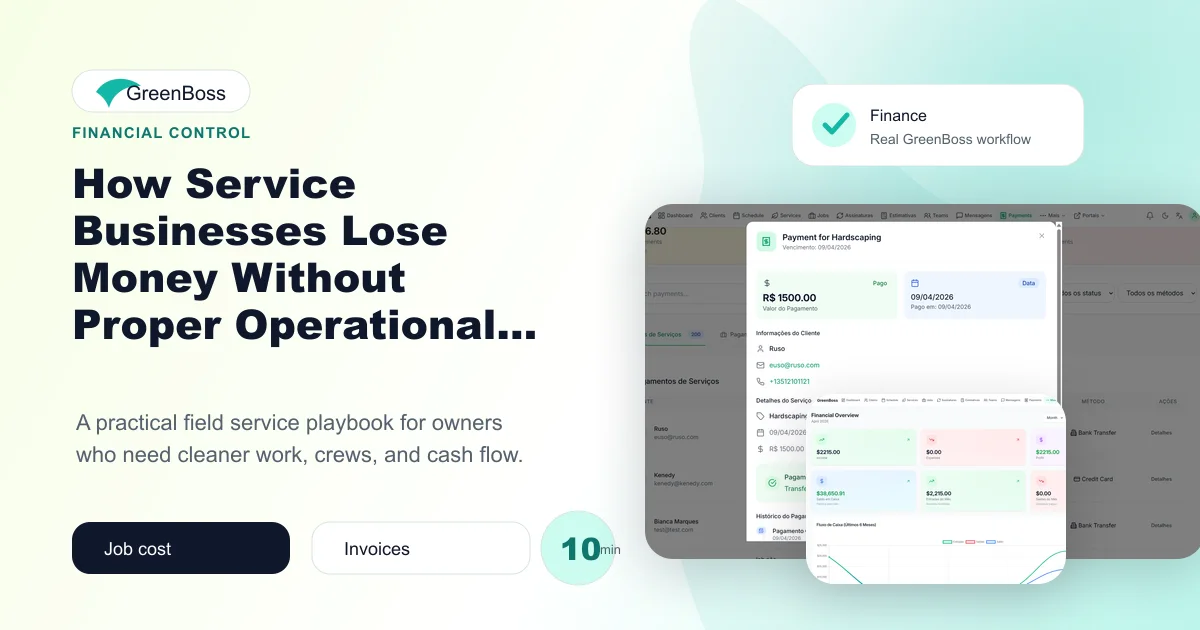
Money does not only leave a service business through obvious expenses. It leaks through an unassigned estimate follow-up, a crew driving to the wrong address, a completed extra not billed, an invoice sent two weeks late, or a callback no one reviews. The issue is rarely effort. It is the absence of a repeatable way to manage labor, materials, billing timing, and cash visibility.
The real operating problem behind service business operational systems
When information is separated across notebooks, texts, spreadsheets, and memory, owners cannot see where operations remove profit. The loss feels like constant busyness rather than a specific fixable process.
Revenue can look healthy while the operation quietly loses money. Service businesses become financially stronger when every completed job leaves a usable record of labor, cost, price, collection status, and the reason a margin changed.
From the fieldA field service company discovers it is not losing money because rates are universally too low. Its losses come from three patterns: same-day schedule reshuffling, undocumented add-ons, and completed jobs waiting for invoicing. System changes recover money without demanding crews work faster.
Owners of small service businesses, including many immigrant-owned companies building a reputation in a new market, often carry this coordination personally. A reliable system is not bureaucracy. It lets the company deliver the same professional promise even when the owner is selling work, helping a crew, or speaking with a client.
A practical framework owners can put to work
Follow the job from lead to payment
Map the steps from request, estimate, approval, schedule, assignment, completion, invoice, payment, and review. Any handoff with missing ownership is a place profit can disappear.
In practice, the office should record this decision where the assigned team can see it, and the team should close the loop before the work is considered complete. That simple discipline prevents the same conversation from happening repeatedly.
Make exceptions reportable
Owners need to see late jobs, unapproved additions, return visits, unbilled completion, overdue payments, and schedule disruptions as lists that can be handled.
In practice, the office should record this decision where the assigned team can see it, and the team should close the loop before the work is considered complete. That simple discipline prevents the same conversation from happening repeatedly.
Improve one leakage point at a time
Choose the recurring loss with measurable impact, assign a process owner, define a weekly signal, and review whether the change actually protects time or cash.
In practice, the office should record this decision where the assigned team can see it, and the team should close the loop before the work is considered complete. That simple discipline prevents the same conversation from happening repeatedly.
How to implement the workflow this week
Do not begin by attempting to fix the whole business in one weekend. Choose the active jobs and recurring clients that will move through the next seven days. Use them to establish the workflow, listen to crew feedback, and remove steps that create work without improving visibility.
- Step 1: Map the complete operating workflow. This step should have an owner and a visible completion signal, so it does not depend on someone remembering it later.
- Step 2: Name owners at every handoff. This step should have an owner and a visible completion signal, so it does not depend on someone remembering it later.
- Step 3: Capture field changes before invoicing. This step should have an owner and a visible completion signal, so it does not depend on someone remembering it later.
- Step 4: Connect completion with billing. This step should have an owner and a visible completion signal, so it does not depend on someone remembering it later.
- Step 5: Track repeated rework or delay. This step should have an owner and a visible completion signal, so it does not depend on someone remembering it later.
- Step 6: Review profit leakage every week. This step should have an owner and a visible completion signal, so it does not depend on someone remembering it later.
At the end of the first week, sit down with the person who schedules work and one crew leader. Ask where information was missing, what created a delay, which client communication helped, and which data should be easier to capture next time. Systems earn trust when they help real people do the job.
What to measure instead of relying on feelings
A system is valuable when it creates a visible improvement. Start with a short review, not a complicated dashboard. Record enough information to answer whether customers received the promise, crews had what they needed, and the completed work translated into healthy revenue.
- Completed work not yet invoiced. Review the result weekly at first, then compare trends after the routine is stable.
- Unbilled changes or add-ons. Review the result weekly at first, then compare trends after the routine is stable.
- Lost labor from rescheduling and rework. Review the result weekly at first, then compare trends after the routine is stable.
- Margin variance tied to operational cause. Review the result weekly at first, then compare trends after the routine is stable.
Measurements should start conversations rather than create fear. If a crew continually misses a planned duration, inspect estimate assumptions, travel, material staging, training, and client scope before treating the result as an employee problem.
Common mistakes that keep the problem alive
- Assuming all losses require raising price. Replace this habit with a recorded decision and a clear next action.
- Adding software without defining workflows. Replace this habit with a recorded decision and a clear next action.
- Measuring revenue while ignoring completion-to-cash. Replace this habit with a recorded decision and a clear next action.
The strongest operators use mistakes as process information. When a problem repeats, they define the missing checkpoint, record who owns it, communicate the change, and review whether it worked on the next set of jobs.
How GreenBoss supports this system
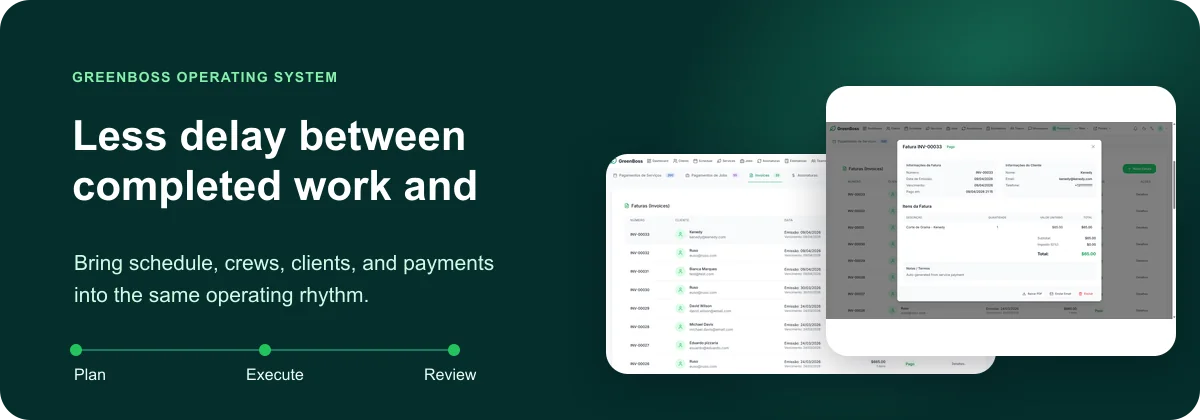
GreenBoss helps landscaping, lawn care, cleaning, hardscape, and field service businesses connect schedules, crews, client records, estimates, completed work, invoices, messages, and reporting in one place. For service business operational systems, that means the next responsible person can see the work and act without rebuilding the story from texts and spreadsheets.
This is especially important for a growing company. More clients should not force the owner to become the only person who knows what is happening. The platform supports a professional routine: plan the work, communicate clearly, complete it with proof, collect revenue, and review the result.
Related GreenBoss playbooks
Continue building the operating system with The Reporting Rhythm Every Service Business Owner Should Review Weekly, Invoice Faster: A Practical Billing Workflow for Field Service Teams, and Payroll Visibility: How to Catch Time Problems Before They Hit Profit. These guides connect the same work from a different operational angle.
A 30-day review for the owner
After four weeks, compare the first week with the most recent one. Review completed work not yet invoiced, ask a crew lead what became easier, and ask the office which exceptions still require manual chasing. Keep the routine that improved delivery; simplify the steps that people consistently avoid; and assign one improvement for the next month.
This review keeps the system grounded in actual work. It also gives an owner a calm way to explain changes to the team: the goal is not more control for its own sake, but fewer preventable problems and a stronger business for everyone doing the work.
Conclusion
How Service Businesses Lose Money Without Proper Operational Systems is ultimately about protecting the promise made to a customer and the time invested by the team. Begin with the next week of real work, clarify ownership, record the important signals, and adjust the process from evidence rather than stress.
GreenBoss helps service businesses organize crews, scheduling, clients, and recurring operations in one place. When you are ready to make this workflow visible across the business, start free with GreenBoss.