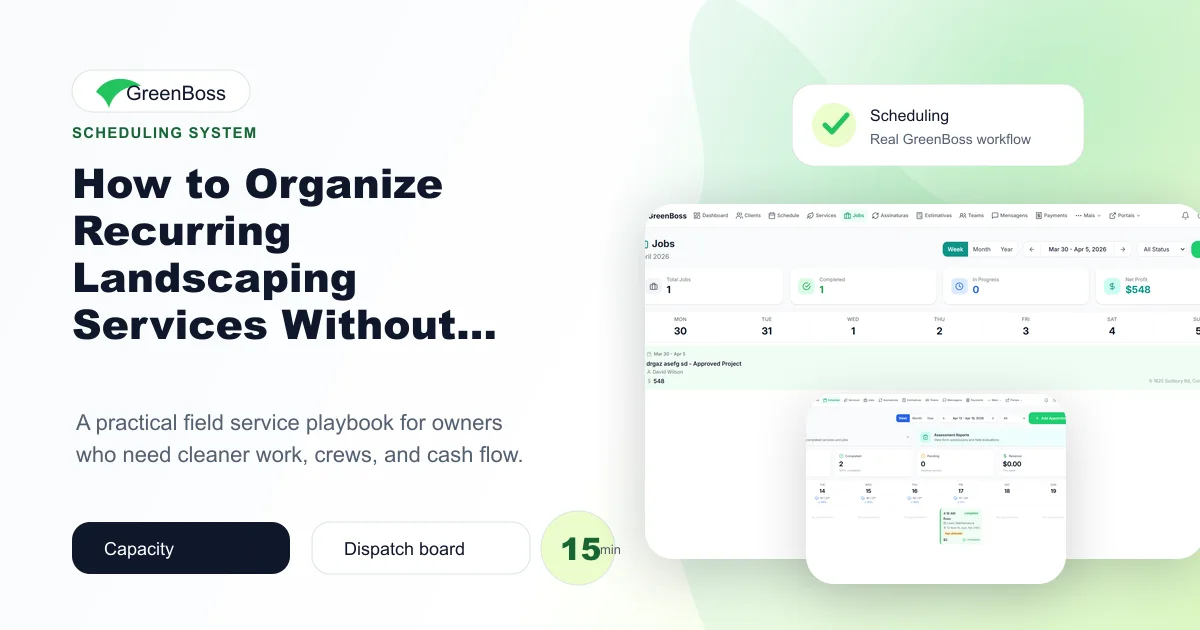
Recurring customers are the stability a landscaping owner works hard to earn. They can also become the source of quiet disorder: skipped gates, forgotten seasonal changes, underpriced extras, and customers who assume every request is included in the monthly rate. The issue is rarely effort. It is the absence of a repeatable way to manage calendar, route, crew capacity, and client expectation.
The real operating problem behind recurring landscaping services management
The risk grows when recurring service is treated as repeating calendar entries instead of a contract-driven operating cycle. Each property needs frequency, scope, preferred window, access notes, seasonal adjustments, billing rule, and an exception path.
A weekly schedule is not a calendar decoration. It is a promise shared by the office, the crew, and the client. When a business plans capacity before accepting every request, the schedule starts protecting margin and trust instead of simply displaying appointments.
From the fieldA 46-property maintenance route uses weekly mowing from April through October and leaf service in November. Rather than rebuilding every visit, the office creates route cycles, records scope per property, assigns recurring crew responsibility, and flags upgrade conversations when crews report beds needing attention.
Owners of small service businesses, including many immigrant-owned companies building a reputation in a new market, often carry this coordination personally. A reliable system is not bureaucracy. It lets the company deliver the same professional promise even when the owner is selling work, helping a crew, or speaking with a client.
A practical framework owners can put to work
Define what repeats and what does not
Write the standard service scope in plain language and separate add-ons such as trimming, mulch, or storm cleanup. This protects both client trust and margin.
In practice, the office should record this decision where the assigned team can see it, and the team should close the loop before the work is considered complete. That simple discipline prevents the same conversation from happening repeatedly.
Schedule cycles by geography
Recurring work becomes predictable when customers in nearby zones share service days. Route density lets the business serve more clients without extending crew hours.
In practice, the office should record this decision where the assigned team can see it, and the team should close the loop before the work is considered complete. That simple discipline prevents the same conversation from happening repeatedly.
Turn exceptions into opportunities
A locked gate, skipped visit, damaged irrigation head, or requested enhancement should create an action record. The operation improves when the next step is documented instead of discussed and forgotten.
In practice, the office should record this decision where the assigned team can see it, and the team should close the loop before the work is considered complete. That simple discipline prevents the same conversation from happening repeatedly.
How to implement the workflow this week
Do not begin by attempting to fix the whole business in one weekend. Choose the active jobs and recurring clients that will move through the next seven days. Use them to establish the workflow, listen to crew feedback, and remove steps that create work without improving visibility.
- Step 1: Record recurring scope and frequency per property. This step should have an owner and a visible completion signal, so it does not depend on someone remembering it later.
- Step 2: Assign properties to route cycles. This step should have an owner and a visible completion signal, so it does not depend on someone remembering it later.
- Step 3: Store access and preference notes. This step should have an owner and a visible completion signal, so it does not depend on someone remembering it later.
- Step 4: Confirm rain-delay rules with clients. This step should have an owner and a visible completion signal, so it does not depend on someone remembering it later.
- Step 5: Review crew-reported additions weekly. This step should have an owner and a visible completion signal, so it does not depend on someone remembering it later.
- Step 6: Audit renewals and pricing before each season. This step should have an owner and a visible completion signal, so it does not depend on someone remembering it later.
At the end of the first week, sit down with the person who schedules work and one crew leader. Ask where information was missing, what created a delay, which client communication helped, and which data should be easier to capture next time. Systems earn trust when they help real people do the job.
What to measure instead of relying on feelings
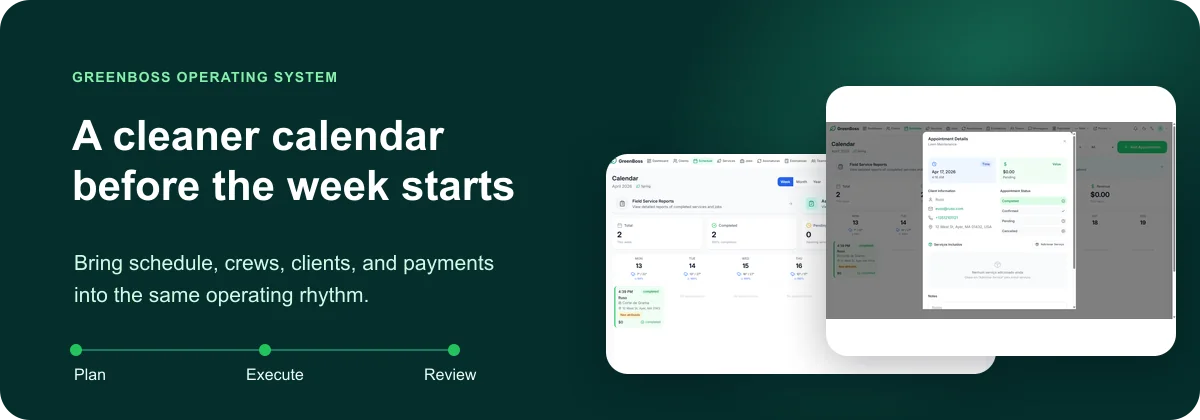
A system is valuable when it creates a visible improvement. Start with a short review, not a complicated dashboard. Record enough information to answer whether customers received the promise, crews had what they needed, and the completed work translated into healthy revenue.
- Recurring completion rate by route. Review the result weekly at first, then compare trends after the routine is stable.
- Average travel time per recurring stop. Review the result weekly at first, then compare trends after the routine is stable.
- Add-on revenue identified from recurring visits. Review the result weekly at first, then compare trends after the routine is stable.
- Credits or callbacks caused by missed scope. Review the result weekly at first, then compare trends after the routine is stable.
Measurements should start conversations rather than create fear. If a crew continually misses a planned duration, inspect estimate assumptions, travel, material staging, training, and client scope before treating the result as an employee problem.
Common mistakes that keep the problem alive
- Promising unlimited extras inside fixed service pricing. Replace this habit with a recorded decision and a clear next action.
- Leaving seasonal transitions to memory. Replace this habit with a recorded decision and a clear next action.
- Moving one recurring client without checking route impact. Replace this habit with a recorded decision and a clear next action.
The strongest operators use mistakes as process information. When a problem repeats, they define the missing checkpoint, record who owns it, communicate the change, and review whether it worked on the next set of jobs.
How GreenBoss supports this system
GreenBoss helps landscaping, lawn care, cleaning, hardscape, and field service businesses connect schedules, crews, client records, estimates, completed work, invoices, messages, and reporting in one place. For recurring landscaping services management, that means the next responsible person can see the work and act without rebuilding the story from texts and spreadsheets.
This is especially important for a growing company. More clients should not force the owner to become the only person who knows what is happening. The platform supports a professional routine: plan the work, communicate clearly, complete it with proof, collect revenue, and review the result.
Related GreenBoss playbooks
Continue building the operating system with The Owner's Guide to Turning One-Time Jobs into Recurring Contracts, How to Build a Weekly Scheduling System for a Growing Service Business, and Service Catalogs: The Quiet System Behind Cleaner Estimates and Jobs. These guides connect the same work from a different operational angle.
A 30-day review for the owner
After four weeks, compare the first week with the most recent one. Review recurring completion rate by route, ask a crew lead what became easier, and ask the office which exceptions still require manual chasing. Keep the routine that improved delivery; simplify the steps that people consistently avoid; and assign one improvement for the next month.
This review keeps the system grounded in actual work. It also gives an owner a calm way to explain changes to the team: the goal is not more control for its own sake, but fewer preventable problems and a stronger business for everyone doing the work.
Conclusion
How to Organize Recurring Landscaping Services Without Losing Control is ultimately about protecting the promise made to a customer and the time invested by the team. Begin with the next week of real work, clarify ownership, record the important signals, and adjust the process from evidence rather than stress.
GreenBoss helps service businesses organize crews, scheduling, clients, and recurring operations in one place. When you are ready to make this workflow visible across the business, start free with GreenBoss.