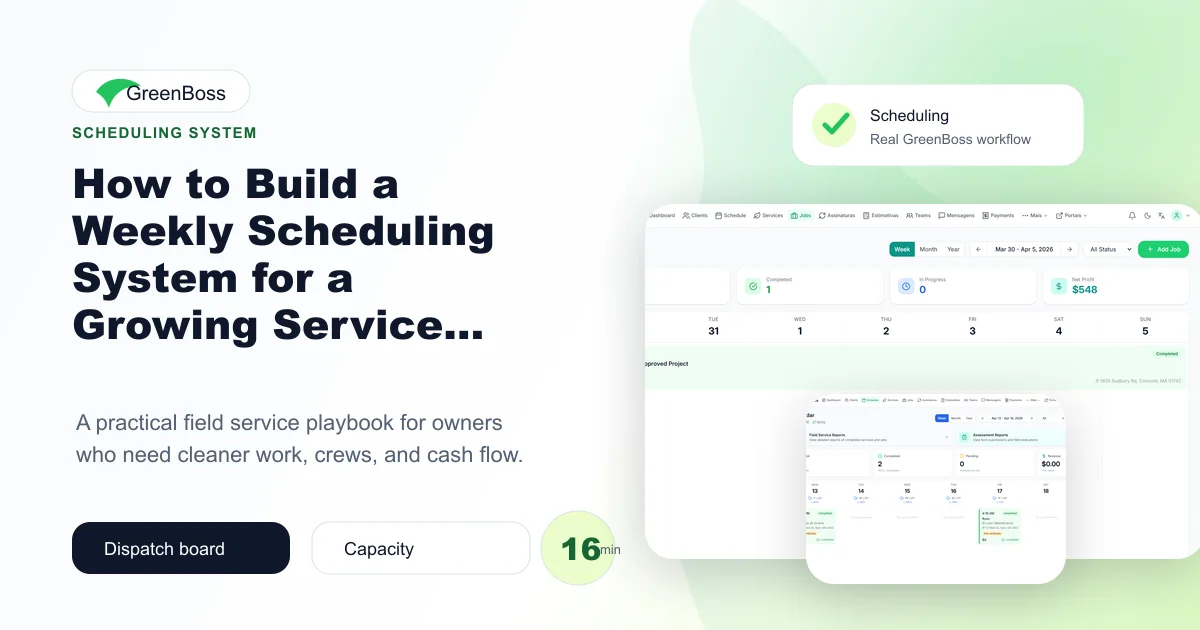
A three-crew lawn care company can fill Monday in five minutes and still lose Friday afternoon to confusion. One rain delay moves twelve stops, two clients request additions, and the owner spends the evening rebuilding a route that nobody else can see clearly. The issue is rarely effort. It is the absence of a repeatable way to manage calendar, route, crew capacity, and client expectation.
The real operating problem behind weekly scheduling system for service business
Growing companies often schedule one appointment at a time instead of planning a week as a capacity decision. Recurring visits, estimate appointments, weather buffers, drive time, and crew skill all compete for the same hours.
A weekly schedule is not a calendar decoration. It is a promise shared by the office, the crew, and the client. When a business plans capacity before accepting every request, the schedule starts protecting margin and trust instead of simply displaying appointments.
From the fieldConsider a company with two mowing crews and one enhancements crew. On Thursday afternoon, the office blocks next week by route area, protects Tuesday morning for rain recovery, assigns recurring customers first, and holds two openings for approved estimates. Monday begins with decisions already made, not with a phone scramble.
Owners of small service businesses, including many immigrant-owned companies building a reputation in a new market, often carry this coordination personally. A reliable system is not bureaucracy. It lets the company deliver the same professional promise even when the owner is selling work, helping a crew, or speaking with a client.
A practical framework owners can put to work
Start with capacity, not requests
List crew days, available field hours, equipment constraints, and travel zones before filling appointments. A full-looking calendar can still be impossible when jobs require the same trailer or the same experienced foreman.
In practice, the office should record this decision where the assigned team can see it, and the team should close the loop before the work is considered complete. That simple discipline prevents the same conversation from happening repeatedly.
Place recurring work first
Recurring contracts fund the week and carry the greatest promise to the client. Schedule them by route and service window, then use remaining capacity for one-time work and estimates.
In practice, the office should record this decision where the assigned team can see it, and the team should close the loop before the work is considered complete. That simple discipline prevents the same conversation from happening repeatedly.
Create an exception review
Every afternoon, review unconfirmed visits, weather risks, incomplete jobs, and requests waiting for a slot. Small adjustments made early avoid major reshuffling later.
In practice, the office should record this decision where the assigned team can see it, and the team should close the loop before the work is considered complete. That simple discipline prevents the same conversation from happening repeatedly.
How to implement the workflow this week
Do not begin by attempting to fix the whole business in one weekend. Choose the active jobs and recurring clients that will move through the next seven days. Use them to establish the workflow, listen to crew feedback, and remove steps that create work without improving visibility.
- Step 1: Define available crew hours by day and skill. This step should have an owner and a visible completion signal, so it does not depend on someone remembering it later.
- Step 2: Load recurring services by geographic route. This step should have an owner and a visible completion signal, so it does not depend on someone remembering it later.
- Step 3: Reserve weather and urgent-work capacity. This step should have an owner and a visible completion signal, so it does not depend on someone remembering it later.
- Step 4: Assign each job with instructions and client notes. This step should have an owner and a visible completion signal, so it does not depend on someone remembering it later.
- Step 5: Send confirmations before crews are dispatched. This step should have an owner and a visible completion signal, so it does not depend on someone remembering it later.
- Step 6: Review completion and rollover work on Friday. This step should have an owner and a visible completion signal, so it does not depend on someone remembering it later.
At the end of the first week, sit down with the person who schedules work and one crew leader. Ask where information was missing, what created a delay, which client communication helped, and which data should be easier to capture next time. Systems earn trust when they help real people do the job.
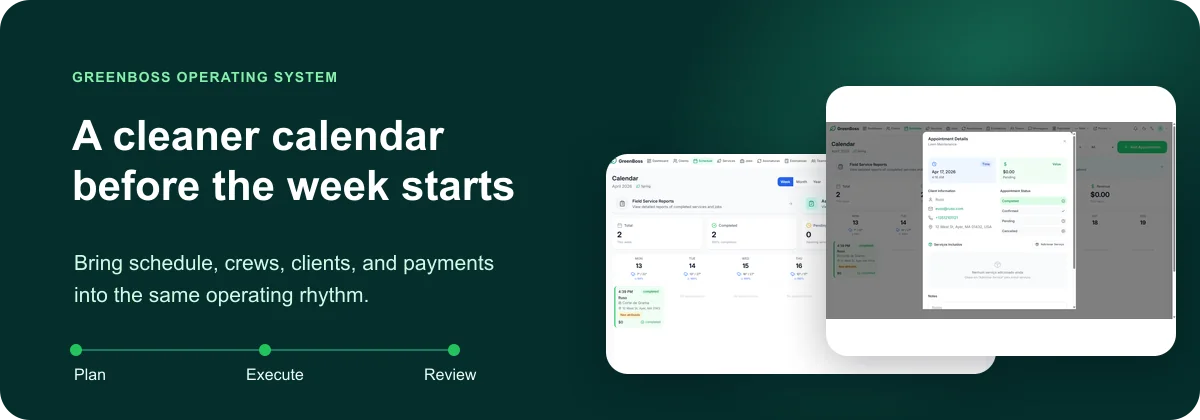
What to measure instead of relying on feelings
A system is valuable when it creates a visible improvement. Start with a short review, not a complicated dashboard. Record enough information to answer whether customers received the promise, crews had what they needed, and the completed work translated into healthy revenue.
- Scheduled hours versus available crew hours. Review the result weekly at first, then compare trends after the routine is stable.
- Recurring visits completed in their promised window. Review the result weekly at first, then compare trends after the routine is stable.
- Appointments changed after client confirmation. Review the result weekly at first, then compare trends after the routine is stable.
- Unassigned or rolled-over jobs at week end. Review the result weekly at first, then compare trends after the routine is stable.
Measurements should start conversations rather than create fear. If a crew continually misses a planned duration, inspect estimate assumptions, travel, material staging, training, and client scope before treating the result as an employee problem.
Common mistakes that keep the problem alive
- Filling every blank opening without travel time. Replace this habit with a recorded decision and a clear next action.
- Keeping schedule changes only in text messages. Replace this habit with a recorded decision and a clear next action.
- Accepting new work before seeing true capacity. Replace this habit with a recorded decision and a clear next action.
The strongest operators use mistakes as process information. When a problem repeats, they define the missing checkpoint, record who owns it, communicate the change, and review whether it worked on the next set of jobs.
How GreenBoss supports this system
GreenBoss helps landscaping, lawn care, cleaning, hardscape, and field service businesses connect schedules, crews, client records, estimates, completed work, invoices, messages, and reporting in one place. For weekly scheduling system for service business, that means the next responsible person can see the work and act without rebuilding the story from texts and spreadsheets.
This is especially important for a growing company. More clients should not force the owner to become the only person who knows what is happening. The platform supports a professional routine: plan the work, communicate clearly, complete it with proof, collect revenue, and review the result.
Related GreenBoss playbooks
Continue building the operating system with How to Reduce No-Shows and Last-Minute Cancellations, Team Maps and Territory Visibility for Multi-Crew Service Companies, and The Reporting Rhythm Every Service Business Owner Should Review Weekly. These guides connect the same work from a different operational angle.
A 30-day review for the owner
After four weeks, compare the first week with the most recent one. Review scheduled hours versus available crew hours, ask a crew lead what became easier, and ask the office which exceptions still require manual chasing. Keep the routine that improved delivery; simplify the steps that people consistently avoid; and assign one improvement for the next month.
This review keeps the system grounded in actual work. It also gives an owner a calm way to explain changes to the team: the goal is not more control for its own sake, but fewer preventable problems and a stronger business for everyone doing the work.
Conclusion
How to Build a Weekly Scheduling System for a Growing Service Business is ultimately about protecting the promise made to a customer and the time invested by the team. Begin with the next week of real work, clarify ownership, record the important signals, and adjust the process from evidence rather than stress.
GreenBoss helps service businesses organize crews, scheduling, clients, and recurring operations in one place. When you are ready to make this workflow visible across the business, start free with GreenBoss.